Vortex Characterization and Detection using a Low-Order Vortex Model
Corey Potvin, A CASA Ph.D. student at the University of Oklahoma, has developed a technique for the objective detection and characterization of tornadoes and other intense vortices in multiple-Doppler radar data. Radial velocity observations from two or more Doppler radars are fit to a low-order analytical vortex model (LOVM) and its near-environment. By using a variational minimization procedure, a mathematical method for finding a solution that best fits the observations, various parameters describing the vortex model are determined. The technique takes advantage of the dual- or multi-Doppler coverage by CASA networked radars to not only detect intense vortices but also estimate important characteristics such as size and strength of the vortices, and has the potential of being able to more reliably detect and characterize tornadoes and other low-level vortices, and reduce high false alarm rate associated with current operational tornado detection algorithms. More reliable detection will help the adaptively scanning CASA radars to more effectively focus limited resources on observing the detected tornadoes or potential tornadoes, and thereby improve tornado warning. Shown below are the results of applying this technique to the CASA IP1 data collected on February 10, 2009. A weak non-tornadic vortex occurred within the network, in an area covered by three CASA radars. The technique successfully estimated the vortex location, size and strength that also indicate correctly that the vortex was not at tornado strength. It is this type of smaller weaker vortices that are more difficult to characterize and they often contribute significantly to false alarms. A paper describing this technique has been accepted for publication in a leading meteorological journal.
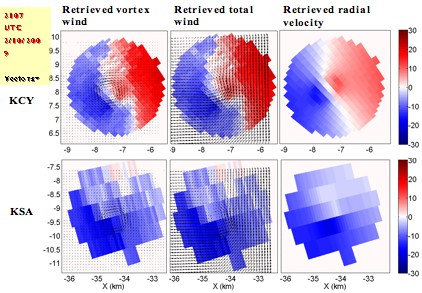
Results LOVM retrieval of a vortex and associated winds in a shear region observed on Feb. 10, 2009 by CASA IP1 radars for a non-tornadic vortex.
|